22 June, 14h00 CEST
GCSP, Bruner Library Room
Registration is required.

Background
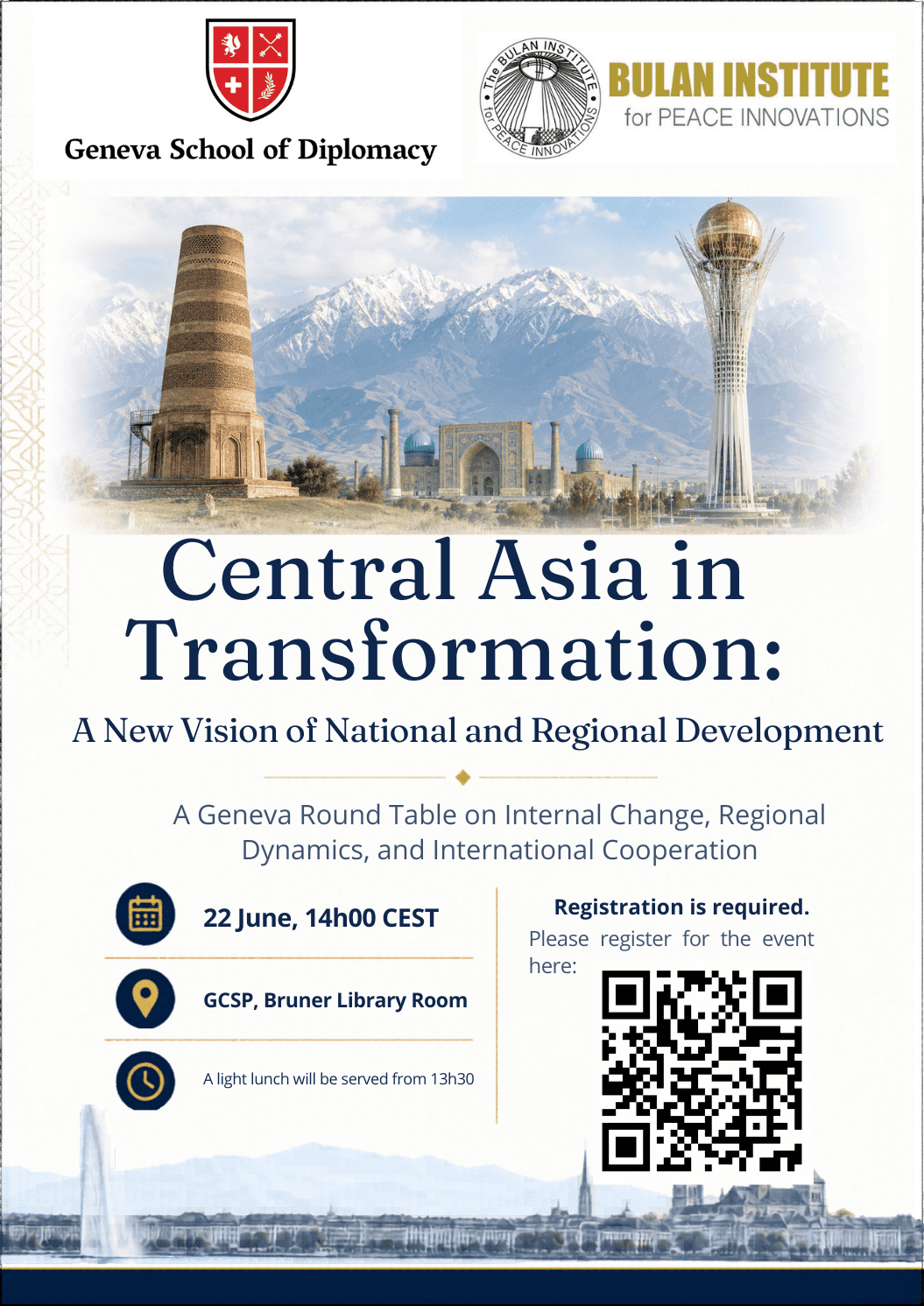
Central Asia is undergoing a significant transformation. The region, comprising Kazakhstan, Kyrgyzstan, Tajikistan, Turkmenistan, and Uzbekistan, is increasingly attracting international attention due to its strategic location, young populations, natural resources, development potential, and growing role in regional and global connectivity. Situated between Europe, Russia, China, South Asia, and the Middle East, Central Asia is becoming an important space for dialogue on governance, development, energy, trade, climate resilience, and international cooperation.
At the same time, countries of the region are undergoing challenging paths of reform and modernization. These include governance reforms, institutional development, constitutional and legal changes, public administration reforms, economic diversification, digital transformation, education, infrastructure development, and human capital investment. While each country has its own national trajectory, the region as a whole is marked by a search for effective development models that can respond to changing domestic expectations and an increasingly complex international environment.
Central Asia is also becoming more visible in global affairs. The region is relevant to discussions on transport corridors, energy security, critical raw materials, water management, climate change, migration, and regional stability. New diplomatic formats and partnerships with Europe, China, Türkiye, the Gulf countries, and international organizations reflect the growing recognition that Central Asia is no longer a peripheral region, but an important actor in a changing world.
Geneva, as a global hub for multilateral diplomacy, development, human rights, humanitarian action, trade, and climate-related dialogue, offers a valuable space to reflect on Central Asia’s transformation. The proposed round table will bring together Central Asian ambassadors, diplomats, experts, academics, international organizations, and civil society representatives to discuss the region’s internal reforms, development priorities, regional dynamics, and future pathways.
Purpose of the Event
The purpose of the round table is to create a constructive Geneva-based platform for dialogue on Central Asia’s transformation. The discussion will focus on national reforms and development priorities, while also examining the region’s growing international role and opportunities for cooperation with Geneva-based actors.
Sessions of the Event
Session 1: National Reforms and Development Priorities in Central Asia
This session will examine some of the ongoing national reforms, institutional modernization, legal and constitutional developments, public administration, digitalization, education, youth, economic diversification, and human development. It will explore how Central Asian countries are responding to new development needs, public expectations, and the demand for effective and resilient institutions.
Session 2: Regional Dynamics in the Region and International Cooperation
This session will examine Central Asia’s growing visibility and importance in international affairs. It will explore how the region is strengthening regional cooperation, developing new diplomatic and economic partnerships, and engaging with key international actors, including Europe, China, Türkiye, the Gulf countries, and multilateral institutions. The discussion will also consider Central Asia’s role in connectivity, trade, energy, climate cooperation, and broader regional stability.
Format of the Event
The event will be organized as a high-level roundtable discussion with short presentations and follow-up discussions.
Format: Round table with expert presentations
Duration: 2.5 to 3 hours
Location: Geneva
Participants: 25–40 selected participants
Language: English
Participants: Ambassadors, diplomats, experts, academics, international organizations, civil society representatives, and Geneva-based policy actors
