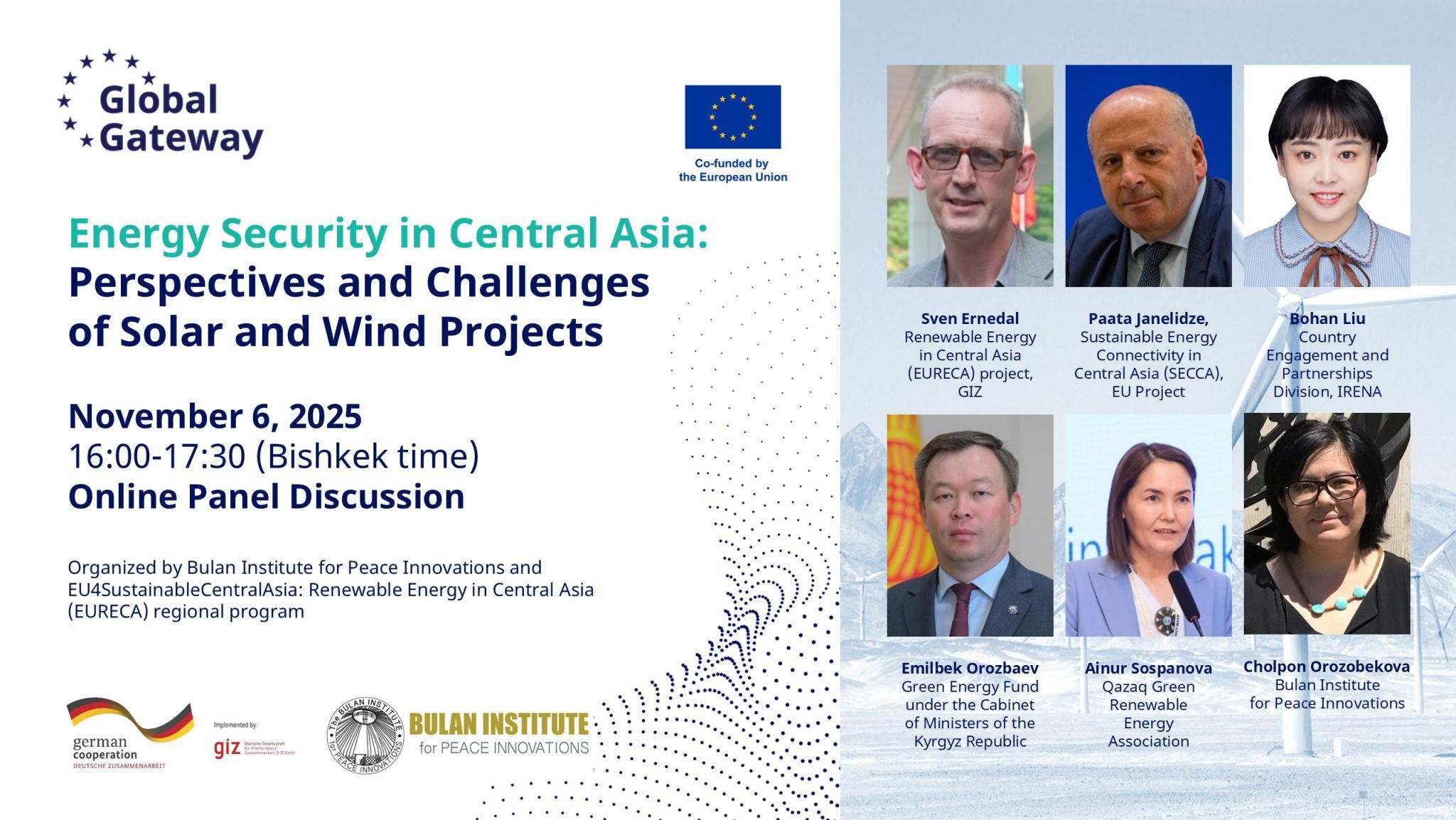
On 6 November 2025, the Bulan Institute for Peace Innovations, in partnership with the EU4SustainableCentralAsia: Renewable Energy in Central Asia (EURECA) programme implemented by Deutsche Gesellschaft for Internationale Zusammenarbeit (GIZ) GmbH, convened a high-level panel discussion titled Energy Security in Central Asia: Perspectives and Challenges of Solar and Wind Projects.
The event brought together international and regional experts to explore the rapidly evolving renewable energy landscape in Central Asia. Discussions focused on flagship initiatives, emerging opportunities, and the structural and policy challenges shaping the deployment of solar and wind energy across the region—an issue that lies at the intersection of energy security, economic resilience, and sustainable development.
The event brought together international and regional experts to explore the rapidly evolving renewable energy landscape in Central Asia. Discussions focused on flagship initiatives, emerging opportunities, and the structural and policy challenges shaping the deployment of solar and wind energy across the region—an issue that lies at the intersection of energy security, economic resilience, and sustainable development.
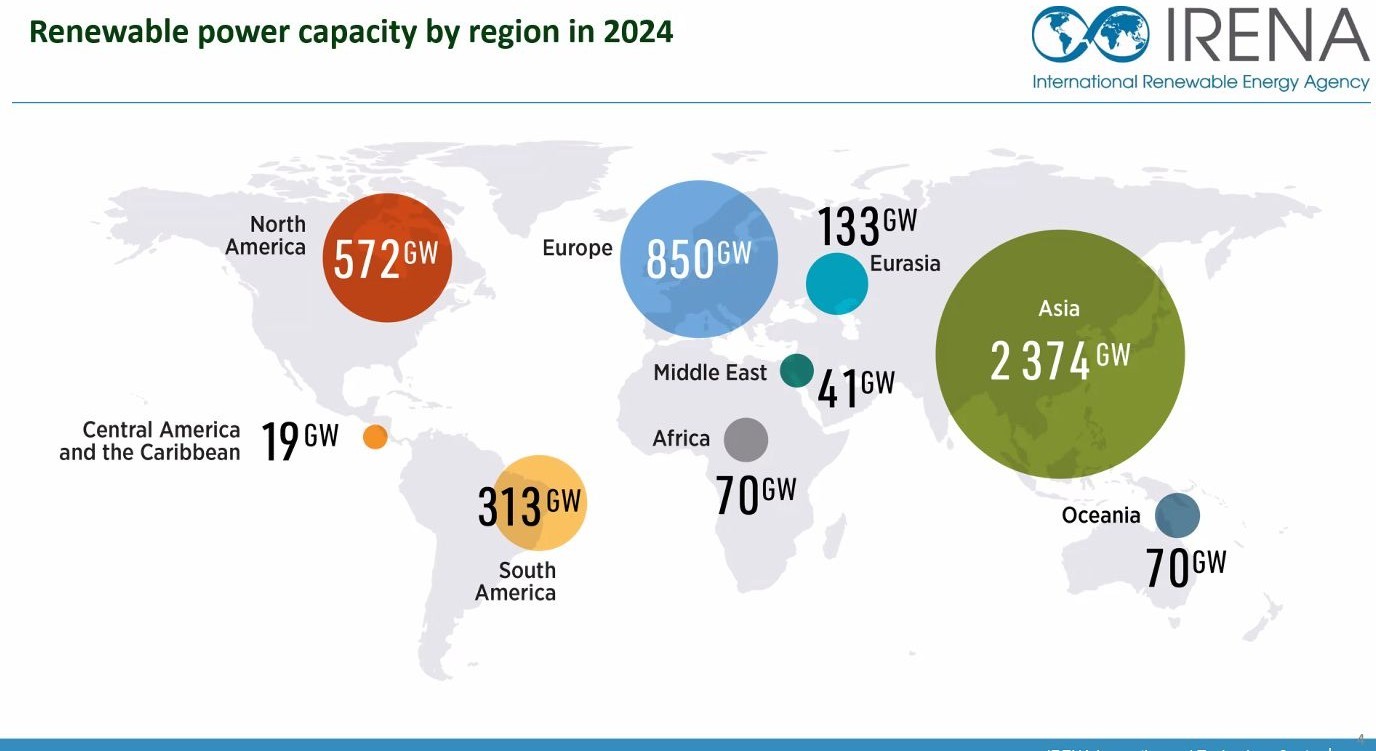
Opening the panel with a global perspective, Ms. Bohan Liu, Renewable Energy Specialist at the International Renewable Energy Agency (IRENA), presented key figures on the worldwide distribution of renewable energy capacity in 2024. Asia now leads the global energy transition with 2,374 GW of installed renewable capacity—surpassing the combined total of Europe and North America. Europe follows with 850 GW, reflecting sustained policy commitment, while North America accounts for 572 GW. In contrast, Eurasia, including Central Asia, represents just 133 GW, highlighting a significant regional disparity.
Opening the panel with a global perspective, Ms. Bohan Liu, Renewable Energy Specialist at the International Renewable Energy Agency (IRENA), presented key figures on the worldwide distribution of renewable energy capacity in 2024. Asia now leads the global energy transition with 2,374 GW of installed renewable capacity—surpassing the combined total of Europe and North America. Europe follows with 850 GW, reflecting sustained policy commitment, while North America accounts for 572 GW. In contrast, Eurasia, including Central Asia, represents just 133 GW, highlighting a significant regional disparity.
These figures underscore a critical paradox: despite strong global momentum, Central Asia remains underrepresented in renewable energy deployment, even though it possesses vast and largely untapped solar and wind resources. As emphasised during the discussion, bridging this gap is not only a climate imperative but also a strategic pathway toward enhanced energy security, increased investment, and long-term regional resilience.
These figures underscore a critical paradox: despite strong global momentum, Central Asia remains underrepresented in renewable energy deployment, even though it possesses vast and largely untapped solar and wind resources. As emphasised during the discussion, bridging this gap is not only a climate imperative but also a strategic pathway toward enhanced energy security, increased investment, and long-term regional resilience.
From a regional policy and implementation perspective, Mr. Sven Ernedal, Programme Manager at GIZ, offered a nuanced assessment of Central Asia’s energy realities. With the exception of Turkmenistan, all Central Asian countries are currently experiencing energy deficits, making the expansion of renewable energy a necessity rather than a choice. While Kazakhstan and Uzbekistan benefit from particularly favourable resource conditions and comparatively low generation costs, Mr. Ernedal stressed that scaling up renewables requires more than additional capacity. Strengthening grid flexibility, addressing curtailment risks, and improving cross-border connectivity are essential steps to ensure the reliable integration of variable renewable energy sources and the stability of national and regional energy systems.
Kazakhstan’s green transition: ambition backed by policy
Kazakhstan’s green transition: ambition backed by policy
The panel also featured impressive insights from Ainur Sospanova on Kazakhstan’s green transition, illustrating how sustained policy commitment can translate into measurable progress. Since 2009, Kazakhstan has built a robust policy foundation—beginning with the adoption of the Law on Renewable Energy and followed by the introduction of fixed tariffs in 2014, auction mechanisms in 2018, and the approval of a Carbon Neutrality Strategy to 2060 in 2023.
The panel also featured impressive insights from Ainur Sospanova on Kazakhstan’s green transition, illustrating how sustained policy commitment can translate into measurable progress. Since 2009, Kazakhstan has built a robust policy foundation—beginning with the adoption of the Law on Renewable Energy and followed by the introduction of fixed tariffs in 2014, auction mechanisms in 2018, and the approval of a Carbon Neutrality Strategy to 2060 in 2023.
Kazakhstan’s renewable energy roadmap reflects both ambition and consistency. The country aims to increase the share of renewables from 3% in 2020 to 15% by 2030, with a long-term objective of sourcing 50% of its energy mix from renewables and alternative sources by 2050. By 2025, Kazakhstan is expected to operate 158 renewable energy facilities with a combined installed capacity of 3,248 MW, already contributing 6.43% of national electricity generation—an important milestone on its pathway toward a low-carbon future.
Kazakhstan’s renewable energy roadmap reflects both ambition and consistency. The country aims to increase the share of renewables from 3% in 2020 to 15% by 2030, with a long-term objective of sourcing 50% of its energy mix from renewables and alternative sources by 2050. By 2025, Kazakhstan is expected to operate 158 renewable energy facilities with a combined installed capacity of 3,248 MW, already contributing 6.43% of national electricity generation—an important milestone on its pathway toward a low-carbon future.